Quetta's Civil Hospital witnessed a horrific acid attack on Dr. Mahnoor Nasir on June 6, 2026. Full incident details, medical updates, accused fate, and calls for justice.
Quetta was shaken on Saturday, June 6, 2026, when a brutal acid attack was carried out on a postgraduate trainee doctor inside Civil Hospital (Sandeman Provincial Hospital) — one of the city's most prominent medical institutions. The victim, Dr. Mahnoor Nasir, was in her duty room when the hospital's lift operator threw acid on her, leaving her with serious burns and sparking nationwide outrage over violence against women and workplace safety in Balochistan.
This incident is not merely a crime report. It is a stark reflection of the deep societal wounds that remain unaddressed — harassment of professional women, inadequate hospital security, and the unchecked availability of acid as a weapon. TrueQuetta brings you the full, verified account of what happened, the latest medical updates on Dr. Mahnoor's condition, and what this tragedy means for Quetta and Pakistan as a whole.
What Happened at Quetta Civil Hospital on June 6, 2026
Dr. Mahnoor Nasir, a postgraduate trainee at Sandeman Provincial Hospital Quetta, was inside her duty room when Hamidun Shah (also referred to as Humayun Shah), a hospital lift operator, knocked on her door and threw acid on her without warning.
CCTV footage from the hospital later confirmed that the attacker had been waiting outside her room, deliberately targeting her. According to investigators and colleagues, Hamidun Shah had been harassing Dr. Mahnoor for several months and had repeatedly been rejected. The attack was a calculated act of retaliation against a woman who simply refused his advances.
Extent of Dr. Mahnoor's Injuries
The acid attack caused burns on Dr. Mahnoor's face, abdomen, legs, and hands. Initial reports estimated burns covering 35–70% of her body, causing widespread alarm. However, the most recent and verified medical updates confirm approximately 13% body surface area burns — still serious, but more accurately assessed after specialized examination.
- Dr. Mahnoor was airlifted to Aga Khan University Hospital (AKUH) in Karachi immediately after the attack for specialized treatment
- Her eyes were affected by the acid, but her vision remains intact
- Plastic surgeons and eye specialists have both examined her
- Her vital organs are confirmed to be safe
- Her overall condition is currently stable
The swift medical response and her transfer to AKUH — a world-class facility — are the key reasons her prognosis is more hopeful than initially feared. The entire nation continues to pray for her full and speedy recovery.
The Accused: Hamidun Shah Killed in Police Encounter
Following the acid attack, Hamidun Shah attempted to flee Quetta. Law enforcement agencies tracked him down, and he was killed in a police encounter near the Noshki bus stop. Police stated that Shah opened fire on the responding police party, leading to the encounter.
CCTV evidence played a crucial role in establishing the timeline of events — showing Shah deliberately waiting and knocking on Dr. Mahnoor's door before carrying out the attack. While the accused has been neutralized, questions remain about how an individual with a history of harassment was allowed to continue working in close proximity to his victim inside a hospital environment.
A Hero in the Darkness – Abdul Razzaq Turakai
In one of the most moving moments of this tragedy, Abdul Razzaq Turakai, a hospital technician who was present at the scene, immediately rushed to Dr. Mahnoor's aid. He placed his own coat over her body to shield her from further exposure to the acid. His act of courage came at a personal cost — he himself suffered burns on his hands and legs.
Turakai's selfless bravery has been recognized at the highest level. Chief Minister of Balochistan, Sarfraz Bugti, has announced a civil award for his heroism. His actions serve as a powerful reminder that even in the darkest moments, humanity prevails.
Protests by Quetta's Medical Community
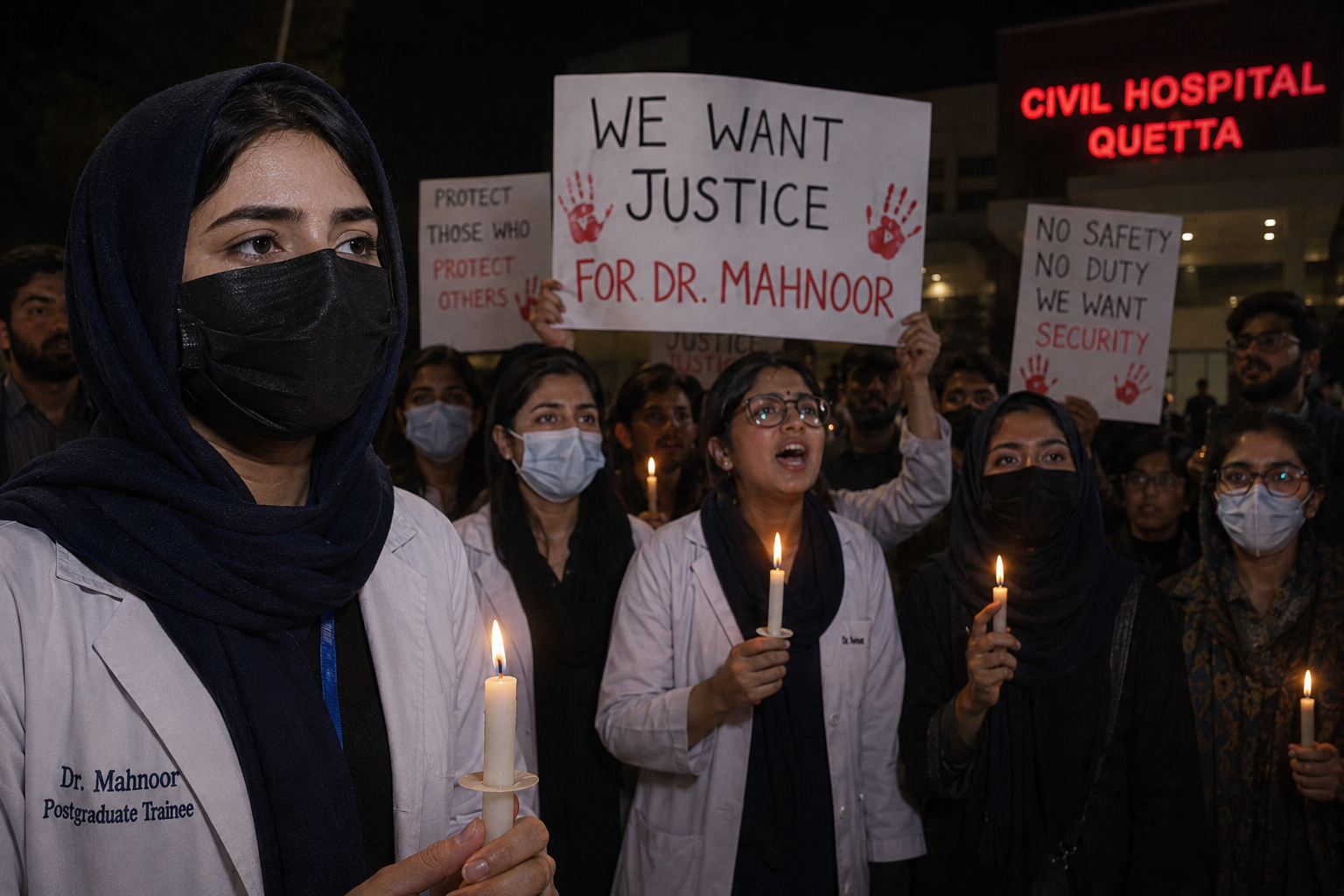
News of the acid attack triggered immediate and widespread protests across Quetta's medical community. Doctors, paramedics, and hospital staff took to the streets and staged demonstrations demanding justice for Dr. Mahnoor and stronger security measures across all healthcare facilities in Balochistan.
The fact that this attack occurred inside a hospital — a sacred space meant for healing and saving lives — made the outrage even more intense. If those who dedicate their lives to serving the sick and injured cannot be safe at their own workplace, it raises fundamental questions about the state of women's safety in professional environments across Pakistan.
The Bigger Picture – Violence Against Women in Professional Spaces
The acid attack on Dr. Mahnoor Nasir in Quetta is not an isolated incident. It is part of a deeply troubling pattern of violence, harassment, and gender-based attacks that continue to threaten women — particularly those breaking barriers in professional fields.
- Acid attacks remain a weapon of control and revenge, too easily carried out due to the unrestricted sale of corrosive substances in Pakistan
- Workplace harassment of women in hospitals, offices, and institutions goes underreported due to fear, social stigma, and inadequate complaint mechanisms
- Female doctors and medical staff already face enormous pressures — long duty hours, understaffed environments — and must not also bear the burden of personal safety threats
This incident demands a national conversation — not just outrage on social media, but concrete legislative and institutional action. For more on opportunities and challenges facing youth in Quetta and Balochistan, read our Quetta Jobs & Scholarships Guide 2026.
What Must Change – Key Demands After Quetta Acid Attack
The acid attack at Quetta's Civil Hospital has renewed urgent calls for systemic reform. Here is what advocates, doctors, and citizens across Balochistan are demanding:
- Strict regulation on the sale of acid — acids and corrosive substances must not be freely available without identity verification and registration
- Comprehensive CCTV coverage in all public hospitals, especially duty rooms, corridors, and staff-only areas
- Dedicated security personnel for female medical staff during night and late-duty shifts
- Fast-track courts for acid attack and gender-based violence cases to ensure swift justice
- Formal harassment reporting systems in all government hospitals with guaranteed protection for complainants
- Psychological support for victims and witnesses of workplace violence
Community Response and the #JusticeForDrMahnoor Movement
Across social media platforms, the hashtags #JusticeForDrMahnoor, #StopAcidAttacks, and #WomenSafety trended in Quetta and across Pakistan following the incident. Citizens, activists, politicians, and fellow doctors flooded timelines with messages of solidarity, prayers for Dr. Mahnoor's recovery, and demands for accountability.
The movement reflects growing public impatience with gender-based violence and a collective demand that institutions — hospitals, courts, and lawmakers — take meaningful action rather than offering condolences and moving on.
FAQ – Acid Attack on Dr. Mahnoor Nasir, Quetta
What is the current condition of Dr. Mahnoor Nasir?
Dr. Mahnoor's condition is currently stable. She is receiving specialized treatment at Aga Khan University Hospital (AKUH) in Karachi. Her vision is intact despite her eyes being affected, and her vital organs are safe. She has sustained approximately 13% body surface area burns.
What happened to the attacker Hamidun Shah?
Hamidun Shah was tracked down by police after fleeing Quetta and was killed in a police encounter near the Noshki bus stop. He reportedly opened fire on the police party, leading to the encounter. CCTV footage from the hospital confirmed his premeditated actions.
What is being done to improve safety for female doctors in Quetta?
Following the incident, doctors across Quetta protested and demanded stronger security measures. The Chief Minister of Balochistan announced a civil award for the hero who aided Dr. Mahnoor. Calls for better CCTV coverage, dedicated security staff, and acid sale regulations are being raised at both provincial and national levels.
Our Message – Dr. Mahnoor, Quetta Stands With You
Dr. Mahnoor Nasir chose medicine to heal others. She deserved safety, dignity, and respect in return. What happened to her inside Quetta's Civil Hospital is a crime against one woman — and a warning to every woman serving in a professional capacity across Pakistan.
TrueQuetta stands firmly in support of Dr. Mahnoor and every healthcare worker who risks their wellbeing to serve this nation. We call on authorities to ensure this tragedy becomes a turning point — not just another forgotten headline.
We pray for Dr. Mahnoor's complete recovery. May Allah grant her full Shifa. Ameen.
For the latest updates on this case and other important news from Quetta and Balochistan, visit TrueQuetta.com — the voice of Quetta, in search of truth.